Destinations
Buying Property in Costa Rica as an American: 2026 Guide
October 20, 2026 · 8 min read · Vasto
In this article
Buying property in Costa Rica as an American is simpler than buying on the Mexican coast in one respect: you can hold titled land in your own name, with the same rights as a Costa Rican. Article 19 of the Constitution gives foreigners the same individual rights as citizens, so there is no bank trust and no residency requirement to own a titled house or lot.
The exception is the beach. The 200 meters closest to the ordinary high-tide line belong to the State under the Maritime Zone Law (Ley 6043), and the rules there are different. On titled property, the verified closing taxes and fees add up to about 3% to 3.4% of the price before stamps, and the annual property tax is 0.25% of registered value.
Buying property in Costa Rica as an American: titled land
Land outside the 200-meter strip, and coastal land that was already legally titled to a private owner, is private property recorded in the Registro Nacional, the national property registry. If a property is titled, a US citizen buys it the way a Costa Rican would: a Costa Rican notary prepares the deed, the transfer is recorded and the title goes in your name.
Compare that with Mexico, where foreigners cannot hold direct title within 50 km of the coast and buy through a bank trust, the fideicomiso. Costa Rica has no restricted strip of that kind for titled land. The step-by-step process for the Mexican side is in our guide on how to buy property in Mexico as an American.
Before you sign anything in Costa Rica, ask the notary to confirm three things:
- That the property is titled, not a concession, and registered in the seller's name.
- How far it sits from the high-tide line, if it is anywhere near the beach.
- The registered fiscal value, which is the floor for the transfer tax and the base for property tax.
The maritime zone: the first 200 meters
The Maritime Zone Law splits the coast into two strips, measured from the ordinary high-tide line.
| Strip | Width | Status | Who can hold it |
|---|---|---|---|
| Public zone | First 50 m, plus mangroves | Public; no one may occupy it under any title | Nobody |
| Restricted zone | Next 150 m | State land, held by municipal concession for 5 to 20 years | Costa Ricans, foreigners with 5+ years of residence, and companies no more than 50% foreign-owned (with the limits below) |
| Beyond 200 m, or land already titled | Everything else | Private property | Anyone, including Americans |
Article 47 of the law bars concessions to foreigners with less than five years of residence. It also bars companies domiciled abroad, companies set up in Costa Rica by foreigners, companies with bearer shares, and any entity more than 50% foreign-owned. Transfers of a concession holder's shares to foreigners are void.
In practice, forming a Costa Rican company does not get an American around the rule. Holders of a concession pay an annual fee (the canon) instead of property tax.
The law does not apply to coastal cities, declared coastal urban zones, or land that was already legally titled (Article 6, as reformed by Ley 9221). Which of these applies to a given lot is a question for the notary and the registry, not for a listing description.
Closing costs and who pays them
| Item | Rate | Notes |
|---|---|---|
| Transfer tax (Ley 6999) | 1.5% | On the real price, never below the registered fiscal value. Split 50/50 by law unless the contract says otherwise. Due within 15 business days of the deed. |
| Registry fee (Ley 4564) | 0.5% | ₡5 per ₡1,000 of value; 0.1% on a mortgage |
| Notary fee (Decreto 41457-JP) | About 1% to 1.2% effective | Sliding scale: 2% on the first ₡11 million, falling to 1% above ₡33 million |
| Stamps and VAT on the notary fee | Varies | Several small stamps (timbres), not one fixed rate |
On a US$500,000 purchase, the three verified items come to about US$15,000 to US$17,000. With stamps, all-in totals of roughly 3.5% to 4% are commonly quoted; treat that as an estimate and ask the notary for a written breakdown before closing.
Property tax and the luxury-home tax
Property tax (Ley 7509) is 0.25% of the registered value, paid to the municipality. A house registered at US$600,000 pays about US$1,500 a year. Owners re-declare the value at least every five years.
An individual's only property is exempt up to 45 base salaries, which is ₡20,799,000 in 2026; tax applies only to the value above that.
The luxury-home tax (impuesto solidario, Ley 8683) applies when the fiscal value of the construction is above ₡143,000,000 in 2026. The threshold fell from ₡145,000,000 in 2025 because inflation was negative. Rates are progressive, from 0.25% to 0.55%, and the tax is paid in the first 15 days of January.
Both thresholds are set in colones, so their dollar value moves with the exchange rate.
Should you buy through a Costa Rican corporation?
Some buyers hold property through a Costa Rican sociedad anónima (S.A.) or limited liability company (S.R.L.). For titled land, it is optional. Before choosing it, count the running costs:
- Corporate tax (Ley 9428): from ₡69,330 a year for an inactive company to ₡231,100 for one with higher income, due in the first 30 days of January. If it goes unpaid, the registry blocks certifications and filings for the company.
- Beneficial-ownership report: every April, companies report their shareholders and ultimate owners to the Banco Central.
- US filings: a US person who owns a foreign company may have to file IRS Form 5471. Property you hold directly is not reported on Form 8938; held through a foreign entity, it can be.
- No help with the beach: as above, a company set up by foreigners cannot hold a maritime-zone concession.
Residency options in Costa Rica
You don't need residency to own property. Buying only leads to residency if the purchase meets the investor rule.
| Category | Requirement | Notes |
|---|---|---|
| Investor | US$150,000 invested | Real estate counts. Granted for 2 years, renewable while you keep the investment. With a mortgage, the down payment must be at least US$150,000. |
| Rentista | US$2,500 a month, stable for at least 2 years | The same income covers a spouse and children under 25 |
| Pensionado | US$1,000 a month of lifetime pension | |
| Digital nomad (Ley 10008) | US$3,000 a month, or US$4,000 with family | Not residency: a one-year stay, extendable once; health insurance required |
Temporary residence is granted for up to two years and renewed. After three consecutive years you can apply for permanent residency, and renewals require enrollment in the CCSS, the national health and social security system.
One change to watch: Ley 9996 gave new investors and retirees duty-free household goods, up to two vehicles and 20% off the transfer tax, but only for those who opted in within five years of July 14, 2021. That window appears to have closed on July 14, 2026, and no extension law had appeared by October 19. Confirm the investor rules with the Dirección General de Migración y Extranjería (DGME) or a Costa Rican attorney before you plan around them.
Getting to Santa Teresa and Malpaís
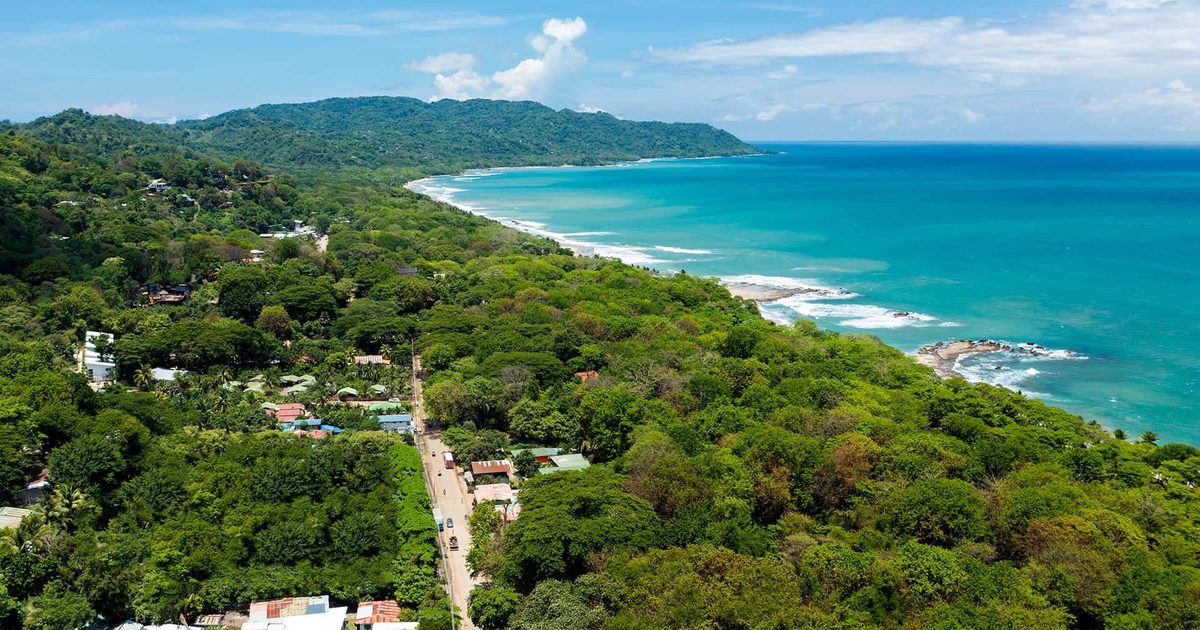
Santa Teresa and Malpaís sit at the southern end of the Nicoya Peninsula, in the district of Cóbano, which belongs to the canton and province of Puntarenas, not Guanacaste. There are three ways in:
- Fly to Liberia (LIR) and drive about 220 km, 3.5 to 5 hours. LIR has nonstops from Charlotte, Chicago, Dallas, Philadelphia, Miami and New York JFK on American; Denver, Houston, Los Angeles, Newark, San Francisco and Washington Dulles on United; Atlanta, Boston and Minneapolis on Delta; plus Southwest, JetBlue, Alaska and Sun Country. Many of these routes fly in winter only.
- Fly to San José (SJO), drive to Puntarenas and take the ferry to Paquera. Naviera Tambor runs eight departures a day each way, at 04:00, 06:30, 09:00, 12:00, 15:00, 18:00, 20:00 and 22:00. A car costs ₡11,400 plus 13% VAT, roughly US$26 to US$27, and an adult passenger ₡810. The crossing takes 60 to 80 minutes, and Paquera to Santa Teresa is 53 km, about an hour. Door to door from SJO, plan on 4.5 to 6.5 hours.
- Fly from SJO to Cóbano Airport, which opened in 2023 and has replaced Tambor for scheduled flights. Sansa and Costa Rica Green Airways fly there; Green Airways lists about six flights a day. The flight takes 25 to 30 minutes, and the airport is about 17 minutes by car from Santa Teresa.
The main road from Cóbano through Santa Teresa to Malpaís has been paved since March 2023. About 90% of the district's 218 km of roads are still gravel or dirt, so side streets are dusty and a high-clearance car helps.
Cabo Blanco, next door
South of Malpaís is the Cabo Blanco Absolute Natural Reserve, established in 1963 by Olof Wessberg and Karen Mogensen and widely described as Costa Rica's first protected area. It covers 1,269 hectares of land and 1,790 of sea. Entry is limited to 40 visitors a day, by reservation, at US$12 for foreigners.
October 2026 listings in the area ranged from about US$120,000 to more than US$850,000 for lots, US$350,000 to US$1.5 million for homes, and US$2 million to more than US$9 million for beachfront and larger villas. These are asking prices from a small sample. For context on the Pacific side of Mexico, see our guide to buying property in Huatulco.
Vasto in Santa Teresa and Malpaís
Vasto has two listings here. Star Mountain is an operating hotel on 90 hectares that border the Cabo Blanco reserve, offered at US$20,000,000. The Grove has jungle lots from US$200,000, with financing. If either fits what you're looking for, we can review title status, distance to the high-tide line and the closing numbers with you before you make an offer.
This guide is general information, not legal or tax advice. Confirm your case with a Costa Rican notary or attorney and a tax advisor.
Frequently asked questions
Sources
Updated October 20, 2026
- Ley 6043, Ley sobre la Zona Marítimo Terrestre (SINALEVI)
- Ley 6999, transfer tax (SINALEVI)
- Ley 7509, property tax (SINALEVI)
- Ley 8764, Ley General de Migración y Extranjería (SINALEVI)
- Naviera Tambor, Puntarenas–Paquera schedules and fares
- Cabo Blanco Absolute Natural Reserve, Costa Rica Tourism Board
Keep reading
Destinations
Huatulco Real Estate: What to Know Before You Buy in 2026
Huatulco real estate in 2026: the bays and areas, flights, the fideicomiso, Santa María Huatulco's 2.5% to 4.75% acquisition tax and what to check first.
October 20, 2026 · 7 min read
Destinations
Puerto Escondido Real Estate: A Buyer's Guide for 2026
Puerto Escondido real estate in 2026: the new highway and US flights, Zicatela to El Puertecito, the fideicomiso, the 2.1% transfer tax, water and storms.
October 20, 2026 · 7 min read
Destinations
Best Places in Mexico to Buy a Second Home in 2026
Huatulco, the Oaxaca Coast, San Miguel de Allende, La Ventana and Amealco. A selection of destinations that in 2026 offer real infrastructure, an active market and a life beyond the resort.
July 31, 2026 · 5 min read